Apr 9, 2026
•
by
Rob Meyerson
Building the Foundation for the In-Space Economy
Lunar Infrastructure
Survival Services
Space Economy
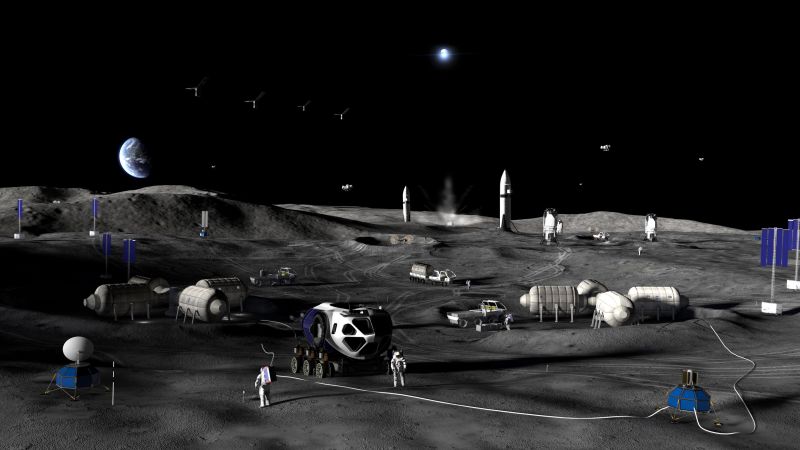
The United States is returning to the Moon, this time to establish a sustainable presence and to utilize its resources to develop a lunar economy. At Interlune, our mission is clear: to lead the world in the sustainable and responsible harvesting of natural resources from space. While we are starting with helium-3, a resource so rare on Earth it commands up to $20 million per kilogram, our vision extends far beyond a single isotope to include the propellants needed to refuel rockets, the metals and rare earths needed to build spacecraft, and even using moon dirt itself to build landing pads, berms, and protective structures for NASA’s Artemis Moon base. In pursuit of our goals, Interlune is developing the fundamental systems and technologies needed to build and operate a sustainable, growing economy not just on the Moon but across the solar system.
The Interlune Harvesting System
To commercialize space resources at an industrial scale, we are developing a proprietary Interlune harvesting system designed to operate autonomously on the lunar surface. This system performs four critical, sequential processes:
- Excavate: To harvest helium-3, we have become great at high-rate continuous excavation of lunar regolith while maintaining extremely low power consumption and tractive force. We’ve been working with Vermeer Corporation on this capability for several years now, and the results have been groundbreaking.
- Sort: Using centrifugal motion rather than gravity, our approach to sorting rocks from fine regolith rapidly isolates the particles most likely to contain valuable solar wind volatile gases, while separating materials to create feedstock for planetary construction.
- Extract: We have pioneered a low-power, highly efficient method of releasing solar-wind volatiles, including helium-3 and hydrogen, that requires 10 times less power than traditional heat-based methods.
- Separate: We have developed a novel approach to ultra-low-temperature cryogenic distillation for enriching helium-3 from solar wind gases. We’re applying this approach today to separating helium-3 from helium here on Earth.
Managing Heat in Extreme Environments
Operating at this scale presents unprecedented engineering challenges, particularly regarding thermal management. Interlune’s surface systems, like any large spacecraft, will generate significant heat that must be managed to maintain reliable system operations over their multi-year lifetimes.
A major hurdle in space is the lack of an atmosphere. Since heat cannot be carried away by air, it must be radiated. The lunar environment is particularly unforgiving, with wide temperature swings near the equator, ranging from -200°F to 250°F. Furthermore, abrasive lunar dust tends to stick to radiators, significantly degrading their performance over time. At Interlune, we’re working on specialized systems for radiating large amounts of heat that are resilient to dust accumulation, ensuring our harvesters can operate continuously throughout the lunar day without overheating.
Bridging the Gap: Cislunar Transportation and Payload Return Capabilities
Another key requirement for Interlune’s lunar helium-3 business is the ability to deliver our products from the Moon back to Earth multiple times per year.
This cadence is vital for establishing a consistent supply chain for high-value resources like helium-3. To accomplish this, we will develop the spacecraft and return capsule needed to carry our precious cargo throughout cislunar space on its journey from the Moon to the Earth.
A Team Built for the Mission
To accomplish this, we have been growing our presence and our team with a focus on understanding and overcoming the unique challenges of the lunar environment. With the opening of our Interlune Research Lab (IRL) in Houston, TX, in addition to our growing headquarters in Seattle, WA, we have built a science and engineering team with a deep, unparalleled understanding of planetary environments. Starting with the expertise of our co-founder and Executive Chairman, Apollo 17 astronaut Harrison “Jack” Schmitt, the only geologist to walk on the Moon, to the technical and leadership capabilities of our Chief Scientist, Dr. Elizabeth Frank, Interlune stands ready to lead or support lunar missions for the Artemis generation.
The IRL team is developing and testing novel simulants of Moon dirt, or regolith, and establishing a broad network of capabilities to test lunar systems using those simulants under environmental conditions that mimic those on the lunar surface. This capability is crucial to testing technology and equipment being developed by industry, government, and academia, including instruments, landers, rovers, and other equipment. In doing so, we are building a team that understands the nuances of regolith composition and the lunar environment, including dust mitigation, solar charging, and other extreme environments that drive design choices.
We’re also building our team through collaboration with other industry leaders. Through strategic partnerships with Vermeer Corp. and Astrolab, we are building systems capable of processing industrial quantities of regolith for site preparation, construction, and resource extraction.
The Road Ahead: Supporting Artemis
Interlune is already working with NASA to help achieve the Artemis program’s goals. For example, under our recently announced NASA STTR contract, we are demonstrating that what we’ve already learned about excavation for helium-3 extraction can be adapted to build roads, berms, and a Moon base. Whether it is burying a nuclear reactor for shielding or preparing a landing pad, we’re building systems designed to operate on the Moon, Mars, or any planetary body.
As NASA accelerates its Artemis program to establish a sustainable lunar presence and then move on to Mars, Interlune is ready to provide even greater support for the construction of the Artemis Moon base. We will leverage our excavation capabilities to break ground on the Artemis base camp, use our sorting technology to produce regolith feedstock for 3D printing, and harness our solar wind volatile extraction technology to produce hydrogen to extract oxygen from moon dirt. And once the Moon base is established, then we will evolve and add capabilities to produce water, split that water into liquid oxygen and liquid hydrogen for use as rocket propellant, then extract metals, rare earth elements, and silicon to support in-space construction. Those are all important adjacent services that will help to build the in-space economy. And the in-space economy is going to be huge.
At Interlune, we believe that the Moon is for all of us. By "Thinking Big" and establishing the infrastructure for an in-space economy today, we are laying the groundwork for a future where space resources sustain humanity for millennia to come.