Apr 28, 2026
•
by
Rob Acree and Gary Lai
NASA and Interlune Collaboration to Enable Commercial Business Case on the Moon
NASA Moon Base
Moon Missions
Hardware
This post is the abstract for a presentation given by Rob Acree at NASA's Lunar Surface Innovation Consortium (LSIC) Spring Conference on April 30, 2026.
Introduction: NASA’s long-standing commitment to technology development and its active engagement in technology transfer have created a foundation for private sector innovation that directly accelerates commercial space exploration and science. Interlune’s upcoming lunar missions exemplify the critical role NASA-developed technologies play in enabling industrial partners to advance capabilities for sustained lunar presence and resource utilization. NASA’s dual role in advancing early-stage research and ensuring these technologies transition into the hands of commercial users, where they can be further matured, applied, and scaled for operational use is critical to developing a sustainable lunar economy.
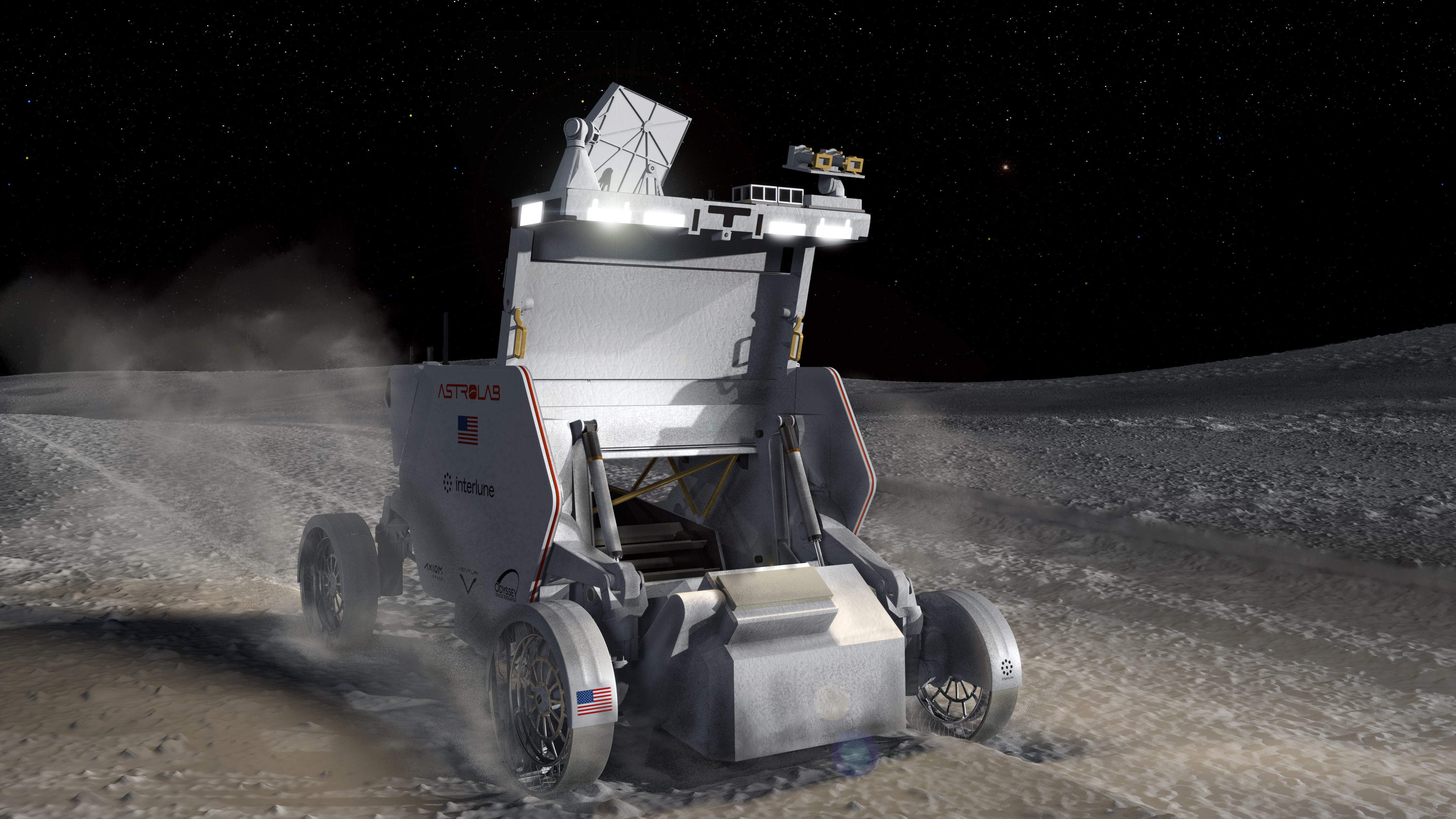
Crescent Moon: Interlune will conduct its first mission to the Moon, dubbed Crescent Moon, on Astrolab’s FLEX Lunar Innovation Platform (FLIP) using the Moon Exploration for Titanium using Active Lighting (METAL) instrument to obtain mineralogical data about the lunar regolith. METAL will be jointly operated by NASA Ames Research Center and Interlune, representing a unique collaboration between commercial partners and NASA.
Prospect Moon: Interlune’s second mission, Prospect Moon, further illustrates the breadth of NASA’s impact by combining NASA-developed instruments and commercial technologies to obtain in-situ measurements of lunar volatiles and to demonstrate their extraction in-situ.
NASA recently awarded Interlune with a Small Business Innovation Research (SBIR) Phase III grant to support the development, testing, and production of flight hardware for the Prospect Moon mission in time for a 2028 launch.
Building upon Crescent Moon, NASA’s METAL technology continues to inspire our work in imaging, forming the basis of a multispectral camera system that will be used to validate remote sensing correlations with 3He content [1].
To understand lunar volatiles, Interlune is planning to take advantage of the development of the Mass Spectrometer Observing Lunar Operations (MSolo) instrument, NASA’s mass spectrometer for volatile detection that operated on the lunar surface as part of the PRIME-1 mission [2].
Interlune is also leveraging heritage from NASA’s most sophisticated planetary analysis tools. The Sample Analysis at Mars (SAM) instrument suite and the Volatile Analysis by Pyrolysis of Regolith (VAPoR) system provide a foundation for our own thermal processing device for extraction of volatiles from lunar regolith.
Finally, we have completed three simulated lunar gravity parabolic flight demonstrations of increasingly mature mechanical processing devices designed to extract solar wind implanted volatiles from lunar regolith. This work has been co-funded by NASA’s Flight Opportunities program. These demonstrations underscore the catalytic role of NASA’s support in reducing technical risk and advancing key system elements toward readiness for space deployment.
Beyond instrumentation, NASA’s investments in the Commercial Lunar Payload Services (CLPS) program has opened the door to commercial missions to the Moon. Several commercial entities now offer payload delivery services, greatly reducing the barrier to entry for lunar surface missions.
Harvest Moon: Looking further into the future of Interlune’s technology roadmap, there are even more technologies that benefit from NASA’s investments. Interlune was recently selected for a Small Business Technology Transfer (STTR) Phase I project to advance trenching and excavation technology. Additionally, work has been in progress to leverage technologies from NASA’s Lunar Terrain Vehicle, taking advantage of existing mobility platform development to support our own Harvester. This further extends to developments in surface power and other infrastructure development. Finally, to deliver Harvest Moon to the lunar surface, Interlune intends to leverage the large cargo capabilities developed to deploy Artemis elements to the surface on a commercial basis.
Conclusion: Together, these examples highlight a broader truth: NASA’s technology development programs and industry partnerships are not just supporting commercial missions, but are fundamentally enabling them. By seeding early innovations, providing access to test environments, and maintaining open pathways for knowledge transfer, NASA ensures that the frontier of exploration is not limited to government missions alone but is expanded by a growing commercial ecosystem.
References:
[1] Fa W. and Jin Y.–Q. (2007) Icarus, 190, 15–23. [2] Gawronska A. J. et al. (2026) LPS LVII, Abstract #1956.