Jul 20, 2026
•
by
Gary Lai
The World Just Got a Little More Resilient
Helium-3
Quantum Computing
National Security
How thinking big brought us back to Earth at the right time
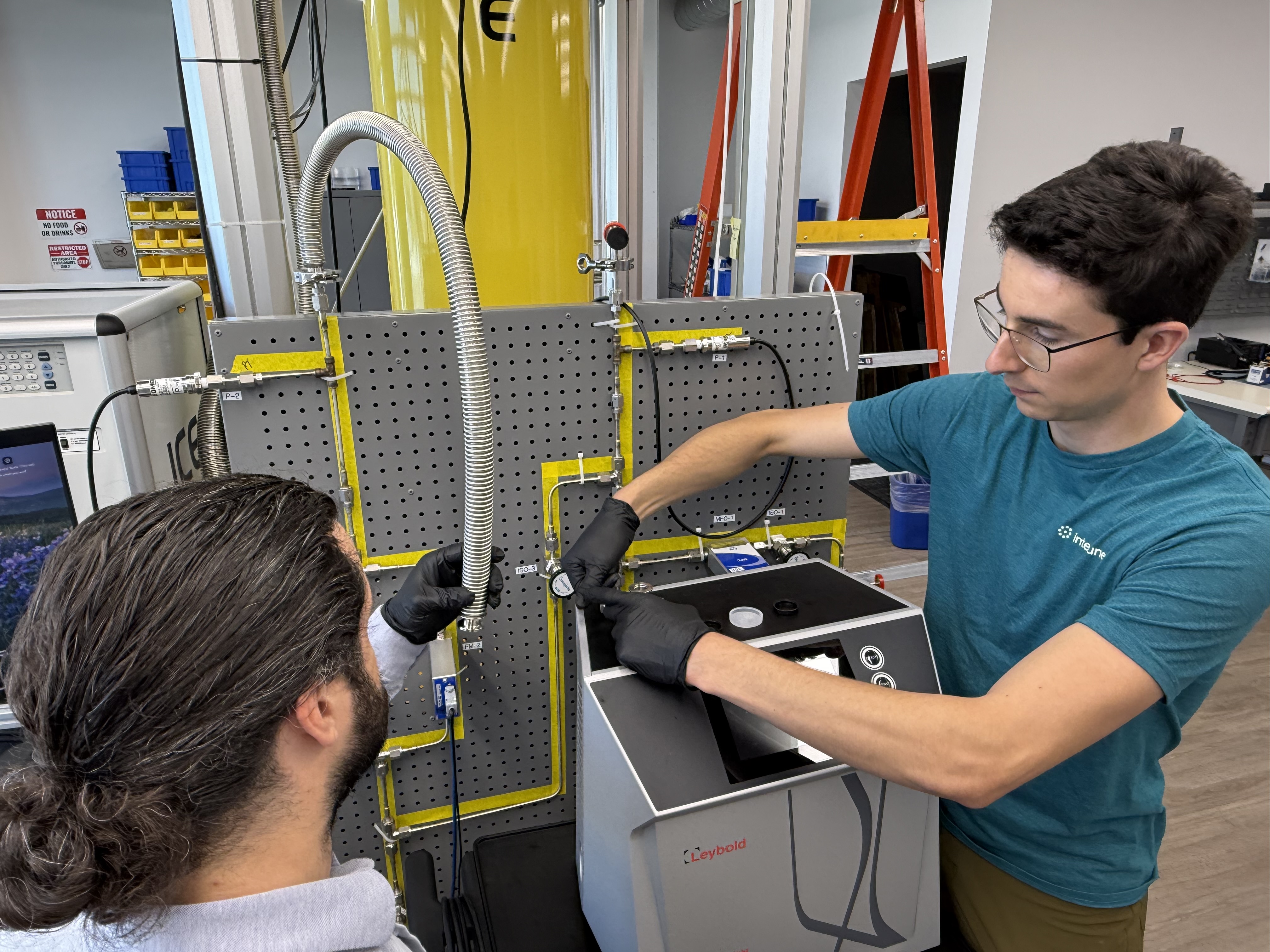
On a Tuesday morning in our Seattle lab, in a column of metal cooled to less than three degrees of absolute zero, we produced 99% pure helium-3, and nobody outside the building knew the world had just gotten a little more resilient.
I have spent my career chasing breakthroughs like this one, like sending dozens of people to the edge of space and returning them forever changed, and landing their rockets softly back on Earth on a pillar of fire. And I can tell you that this one, quiet as it was, belongs on the list.
Helium-3 is one of the most consequential materials most people have never heard of. It is what keeps quantum computers cold enough to solve the world’s most difficult problems; what border agents rely on to sniff out smuggled plutonium; what can produce incredibly detailed medical imagery for diagnosis of many diseases; and what could one day fuel a fusion reactor that produces abundant energy with almost no radioactive waste or carbon emissions. And almost none of it is available on Earth. The U.S. makes about one kilogram a year. The entire world makes less than four.
.jpg)
Why it matters
Everyone should care about this story because this material, which has the potential to vastly improve our lives in the future, is currently extremely scarce, produced primarily by the slow radioactive decay of nuclear weapons stockpiles built during the Cold War, and rationed by the U.S. government.
I came to this problem the long way. In school, I studied astrophysics, economics, and aerospace engineering. Since I was a child, I have been convinced that the key to solving the long-term existential problem of civilization - that the Earth’s resources are finite but humanity’s use of them is constantly growing - is either to permanently cap economic growth, or to access the limitless resources in outer space. I chose to devote my career to the latter. I spent 25 years designing, building, and testing reusable rockets, including flying one into space myself. During my career, in small part due to my efforts, reusable rockets have gone from a nice idea to an everyday reality, and the cost and safety of space transportation have vastly improved. I mention this not for the résumé but because it's relevant to what follows: space engineers are trained to distrust the word "eventually." We learn that the gap between "the physics works" and "the physics works reliably, at scale, on a schedule investors believe" is where most good ideas go to die. Bridging that gap requires constantly thinking big, inventing, building, testing, and persisting.
Here is one thing almost nobody realizes: every liter of ordinary helium, the same helium that fills party balloons and cools MRI machines, already carries trace amounts of helium-3, a few hundred parts per billion, an isotope hiding alongside its own more common sibling, helium-4.
Enter Cold Capture
The U.S. produced roughly 81 billion liters of Grade A helium last year alone. All of that helium-3 has simply been passing through liquefaction plants, unrecovered, because nobody had a practical way to separate it. We do now. It is a technology we call Cold Capture, and in November, the U.S. Air Force, through its AFWERX innovation arm, awarded us a contract to pursue it, because the Pentagon has the same math problem the quantum computing industry has: not enough helium-3, and no obvious economical way to make more.
The way Cold Capture works is, like many hard engineering problems, elegant in principle but difficult in practice. Cool a mixture of helium-3 and helium-4 gas down to just above absolute zero, colder than deep space, and helium-4 will become a liquid while helium-3 will remain a gas. In a column, helium-3 drifts to the top, and helium-4 settles toward the bottom. The difference in volatility is tiny, but it is enough. With our lab-scale system, we have demonstrated taking ordinary helium with trace amounts of helium-3, just a few hundred parts per billion, and producing nearly pure helium-3. Cold Capture exploits a subtle physical difference between the two isotopes at cryogenic temperatures, in a process designed to scale. Deployed across America's existing helium infrastructure, that process could generate up to 2.5 kilograms of helium-3 a year, nearly tripling U.S. production, without a single new well or foreign supplier.
None of that, on its own, would be enough to justify a company built around going to the Moon. What makes Cold Capture matter to Interlune specifically is that the process we're demonstrating on Earth is the same process our Harvester will need on the lunar surface. Our plan for the Moon involves excavating regolith, releasing the gases that have accumulated in it since roughly the beginning of the solar system, and separating helium-3 from that mixture using the same cryogenic distillation principle we're now running in Seattle.
The distillation column geometry will be different. The feedstock concentrations will be different. Operating on a world with no atmosphere to speak of; in extreme cold and hot temperature swings; in one-sixth of Earth’s gravity; introduces entire categories of engineering problems. But when cooled to the right temperature, helium-3 gas rises and helium-4 liquid sinks in both places. We are learning a lot about how to do it on the Moon by doing it on Earth first.
The business side
This is also a business story. Interlune has already signed nearly half a billion dollars and counting in binding purchase agreements for helium-3, mostly with Maybell Quantum and Bluefors, two companies that build the dilution refrigerators quantum computers need to operate near absolute zero. Based on conversations with manufacturers across the industry, we expect quantum computing alone to require tens of kilograms of helium-3 per year by the early 2030s, roughly 10 times global production today. That gap is why the White House issued an executive order this year on quantum innovation, why the Department of Energy launched an initiative to secure the isotope, and why language about helium-3 supply has found its way into a defense appropriations bill.
Cold Capture is our answer to the part of that gap we can close before we ever leave the atmosphere: a domestic helium-3 supply chain that does not depend on a weapon stockpile, export policy, or nuclear waste.
Cold Capture on Earth can never produce enough helium-3 to meet the demand we're staring down, not at an industrial scale for quantum computing, not for fusion energy, not for the abundance this material could genuinely unlock. For that, we have to, and we will go back to the Moon. Even a few hectares of the Moon contain more helium-3 than we can extract from the entire US annual helium supply, making the Moon the ultimate scalable source. But we're going with a technology we've already demonstrated works, tested 400,000 kilometers closer to home.