Oct 13, 2026
•
by
Rob Meyerson
A Guided Tour of Our Prospect Moon Mission
Lunar Resources
Hardware
NASA Moon Base
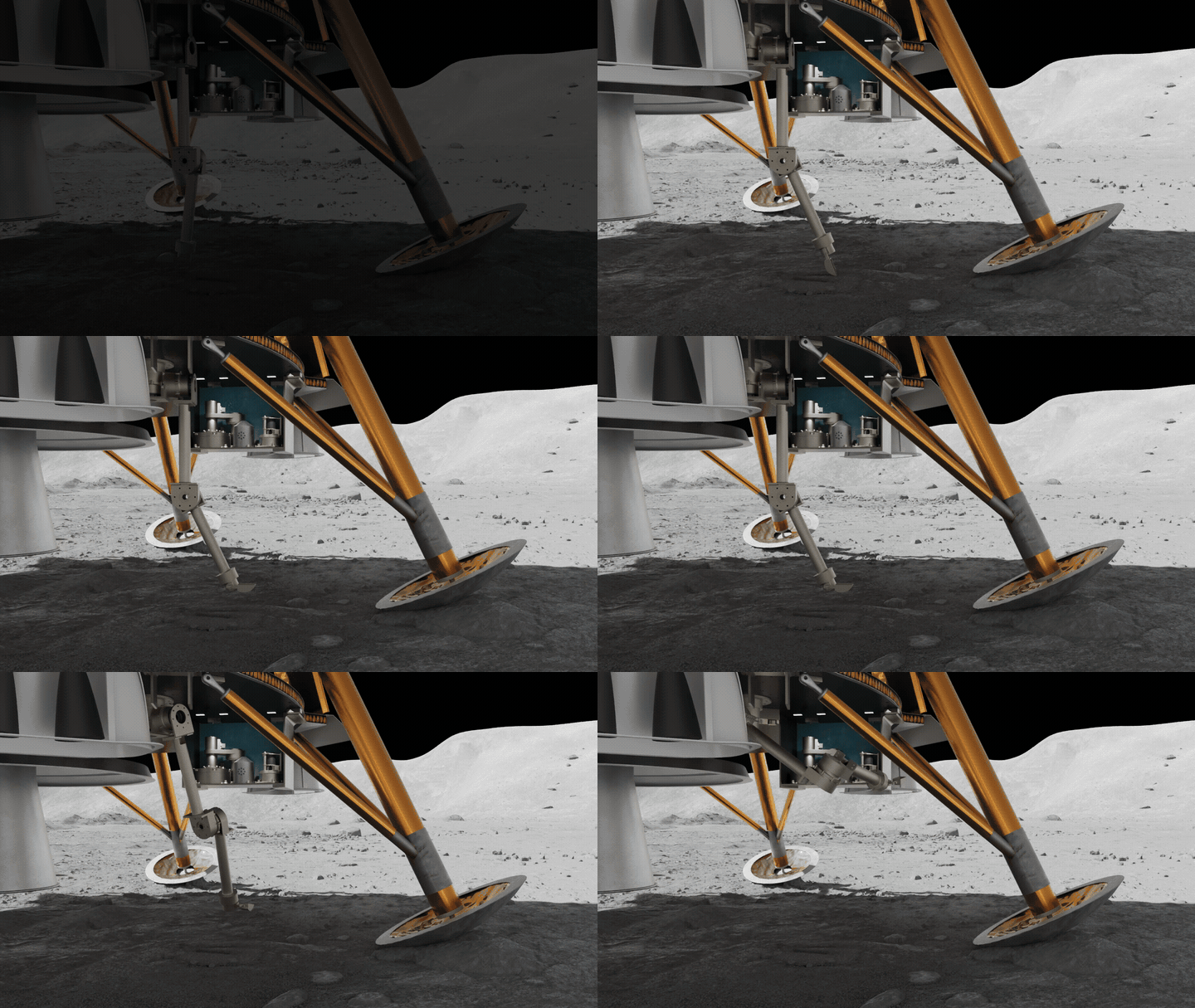
Prospect Moon is a mission designed to answer two closely connected questions: what resources are in lunar soil (regolith), and what will it take to extract them?
Interlune developed a detailed animation to bring Prospect Moon to life, revealing a carefully designed testing protocol that accomplishes multiple objectives with a single payload: measuring gas quantities and concentrations in the regolith and demonstrating the technologies to extract them.
The payload includes a custom-designed suite of hardware: a robotic arm and scoop; a device to heat a regolith sample to 950 deg C; a device to mechanically process a regolith sample via milling; a regolith-sorting device; a multi-spectral camera; and a mass spectrometer. Interlune-developed avionics and software control these systems.
The robotic arm and scoop will collect three samples of lunar soil, or regolith.
The first scoop will be heated to release volatile gases from the regolith, and the mass spectrometer will measure their concentrations.
The second scoop will test Interlune’s mechanical processing technology to release gases, and the mass spectrometer will again measure concentrations.
By comparing gas concentrations from both thermal and mechanical processing, Interlune will confirm that its mechanical processing technology, which uses about 10 times less power than the thermal method, releases gases at sufficient concentrations to harvest resources at scale.
The third scoop will test Interlune’s technology to sort lunar regolith by grain size, a separate step in the harvesting system.
For each scoop, a multispectral camera will flash at multiple wavelengths to collect data on titanium levels and regolith age. Using this data and comparing it with measurements from other datasets, Interlune can predict the amounts of solar wind gases, including helium-3, present in the regolith. An imaging camera will take photos during the mission to document the process.
Supported by a $6.9 million NASA contract, Prospect Moon will provide valuable data to support NASA’s Moon Base Phase 1 objectives, as these technologies are fundamental to sustaining a long-term lunar presence.
Data from the mission will provide Interlune, NASA, and the lunar science community with valuable insights into solar wind volatile concentrations and Moon mineralogy. It will also inform the development of technologies that support the construction of the Artemis Moon Base and Interlune’s harvesting system.
The payload will be ready for integration on a lander in September 2027, and Interlune is actively seeking a ride for a 2028 launch.
Follow us on social media for more videos and updates like this one.