Sep 15, 2026
•
by
Rob Meyerson
Moon Base is the Founding HQ for the Space Economy
Moon Race
Lunar Infrastructure
Space Economy
We founded Interlune because we believe an in-space economy is inevitable.
Four primary converging factors – reliable and affordable launch, diverse capital sources, demand for natural resources, and geopolitical pressure – created an investable business case.
Initially, we focused solely on harvesting helium-3 from the Moon, with plans to expand to other resources like metals, rocket propellant, and rare earth elements over time. At $20 million per kilogram, helium-3 is the only natural resource in the universe valuable enough to bring back to Earth from space. By starting with a space resource that has a real market on Earth today, we can pave the way for harvesting resources in space for use in space as in-space markets develop.
We’ve made solid progress, with about $500 million in binding purchase orders for helium-3 deliveries on Earth, including agreements with Bluefors and Maybell Quantum, two leading suppliers of cryogenic systems to the quantum-computing industry, and the Department of Energy. We also have a growing portfolio of government co-funding to advance core technologies including high-volume excavation, material size sorting, extraction of solar wind gases, and cryogenic distillation.
NASA’s well-timed Moon Base commitment
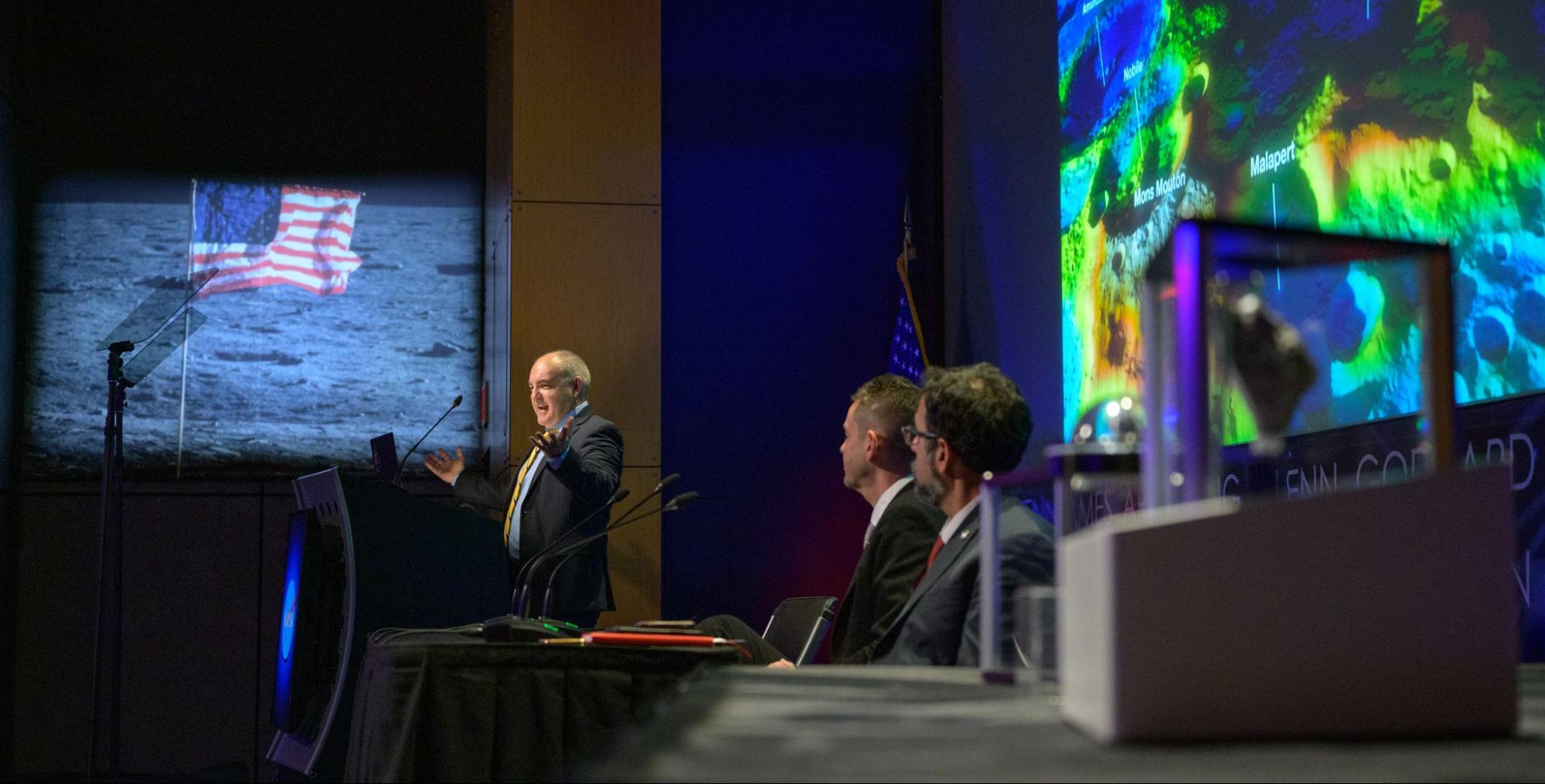
Interlune developed its roadmap to create a self-sustaining lunar presence without long-term government support. Then last March, NASA announced the Moon Base program, a 10-year, three-phase initiative to build and operate a long-term human presence on the Moon. This commitment, backed by $30 billion in investment over the next decade, expands and accelerates Interlune's business plan.
When we set out to build the infrastructure for commercializing resources from space, NASA’s Moon Base program didn’t exist, and yet, it’s tailor-made for our mission.
We’re ready for the most demanding jobsite in history
The technologies and systems Interlune has been developing to harvest helium-3 and other natural resources from space are also required to build and operate a Moon Base.
NASA will need to excavate and process industrial quantities of Moon dirt, or regolith, to clear landing pads, build roads, berms, and construct habitats.
We know how to clear and stabilize a construction site on Earth, but that same work on the Moon is different in nearly every respect. The Moon has one-sixth of Earth's gravity, no atmosphere, extreme temperatures, high radiation levels, and lunar regolith is especially punishing for machinery.
For the past several years, Interlune has built and tested hardware specifically for the lunar environment.
One technology stack, multiple markets
As Interlune pursued its core Excavation, Sorting, Extraction, and Separation technologies over the past several years, we have identified applications for those technologies in other domains. The systems we’re developing to harvest natural resources in space also have applications on Earth, provide the industrial infrastructure for the Moon Base, and support operations on Mars and beyond.
In partnership with Vermeer Corporation, Interlune developed a novel excavator specifically for the lunar environment and is now working to develop critical infrastructure for a permanent presence on the Moon. These systems, including site preparation and construction tools, operate autonomously, tolerate dust, are highly energy efficient, and can survive the long lunar night. While designed for the Moon, these technologies may also have uses on Earth.
Extraction, another key step in the harvesting process, releases gases implanted in the lunar regolith by the solar wind. In order to test the extraction technology itself, Interlune implanted helium into an off-the-shelf regolith simulant, creating a testing material that’s analogous to what the machinery will encounter on the Moon. Because Interlune can produce this material in sufficient quantities for the first time, the company intends to make it commercially available to others building Moon-bound hardware.
While developing the cryogenic distillation technology needed to separate helium-3 from extracted solar wind gases, Interlune discovered the same technology could recover helium-3 from existing Grade A helium on Earth. As a result, Interlune’s Cold CaptureTM technology is being integrated with U.S. helium plants to triple the domestic helium-3 supply in the near term. The Air Force is co-funding this effort to support its research and development programs involving superconducting quantum computers, which use helium-3.
Finally, the Interlune cargo-return system, which will bring helium-3 to Earth several times per year, can also return lunar samples and products manufactured in space.
Survival products and services
The specialized tools and testing capabilities Interlune is developing to prepare its machinery for the extreme conditions of the Moon and space are in growing demand across the broader industry.
To that end, we centralized these efforts at the Interlune Research Lab (IRL) in Houston, near NASA’s Johnson Space Center. At the IRL, we produce representative regolith simulants for hardware verification on Earth and novel systems for off-world industrialization, including dust-tolerant actuators, electrodynamic dust shield technology, and novel energy storage devices.
The natural extension of our NASA partnership
Interlune is working closely with NASA and its partners to develop payloads and technologies for Moon missions, with two Moon Base missions in progress, and a third coming soon.
Crescent Moon
Under a NASA Space Act Agreement, Interlune obtained the Moon Exploration for Titanium with Active Lighting (METAL) instrument from the Ames Research Center and funded its flight to the Moon on Astrolab’s FLIP rover. The mission will generate data on the mineralogical composition of lunar regolith. Interlune and NASA will analyze and publish the findings.
Lunar Terrain Vehicle
Under a separate subcontract with Astrolab, Interlune is part of the team developing the crewed lunar rover for the Artemis Crewed Lunar Vehicle program (CLV-1) and is responsible for dust mitigation, charge modeling and mitigation, simulants, and detailed lunar environments. CLV-1 will fly on a future Moon Base mission.
Prospect Moon
Under a $6.9 million NASA SBIR Phase III contract, Interlune is developing a payload to prospect for lunar resources, investigate the lunar environment, and demonstrate resource extraction from lunar regolith using both thermal and mechanical processing devices. This payload will provide valuable data to support NASA’s Moon Base Phase 1 objectives for understanding the lunar environment and demonstrating technologies useful for building a lunar presence. In addition to those devices, this payload suite includes a custom robotic arm, avionics and software, a multi-spectral imager, and a mass spectrometer. The payload will be ready for integration on a lander in September 2027, and Interlune is actively seeking a ride for a 2028 launch.
The Moon Base as an organizing point
The NASA Moon Base program, following the success of Artemis II, gives industry a common objective: establishing self-sustaining off-Earth operations at scale.
Interlune's role is to build infrastructure and natural-resource supply chains backed by commercial demand for our products. We’re developing key technologies to operate equipment for long periods on the Moon and sustainably extract resources there. We will buy launch and landing services, mobility, power generation, and communications from others in the ecosystem.
As a company, we’ve always seen harvesting natural resources from space as the key enabler to building the industrial backbone of the space economy. That vision now includes providing the critical infrastructure to build the Moon Base itself.
We’ve grown our team and our footprint to answer the call, adding experts in planetary science, plasma physics, mechanical engineering, high-power electronics, testing, and materials and processes. With our growing facilities and teams in Seattle and Houston, Interlune can serve NASA and commercial customers at a larger scale and lead the creation of an in-space economy.
History has its eyes on now
Throughout history, we recognize certain times as inflection points when everything changed. We’re living in one of those times, and increasingly, the world knows it.
For investors: Interlune and its partners are shaping the first off-Earth economy as China races to do the same. Now is the time to secure your position in this emerging market.
For partners building transportation, power, and communications for the Moon, and the NASA teams scoping the next phase of the Moon Base: we're now ready to move even faster.
For prospective team members: reach out and tell us how you can contribute to this once-in-a-career opportunity. We’d love to hear from you.
Image Credit: NASA / Bill Ingalls